Traffic Bike Rider Rush
DT Trading LabRacing
4.398.00 Reviews
- Version
- 1.2.2
- Installs
- 10.00M
- Age Rating
- Everyone
Screenshots
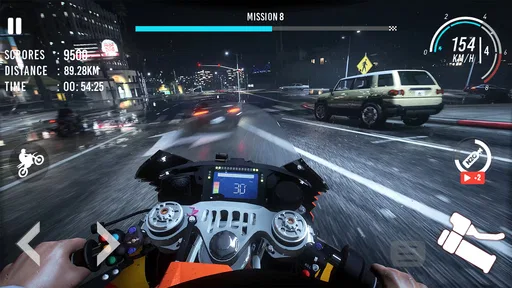
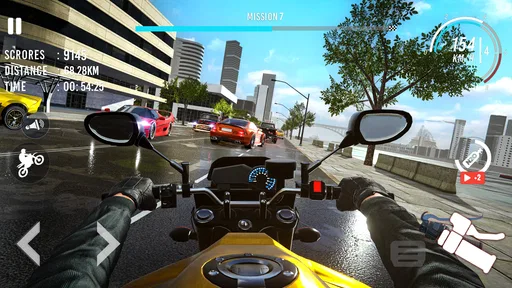
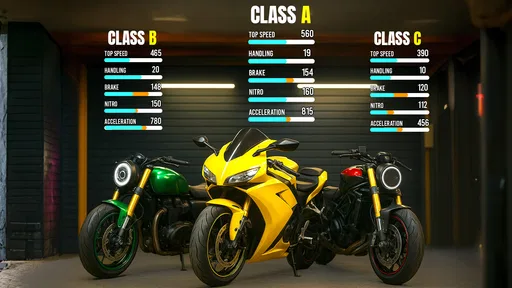
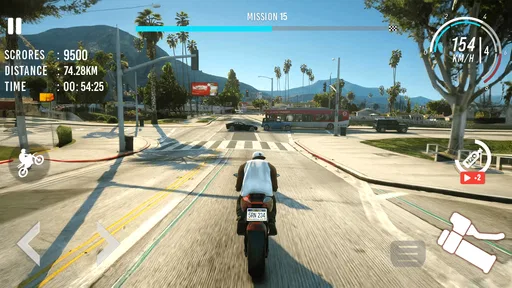
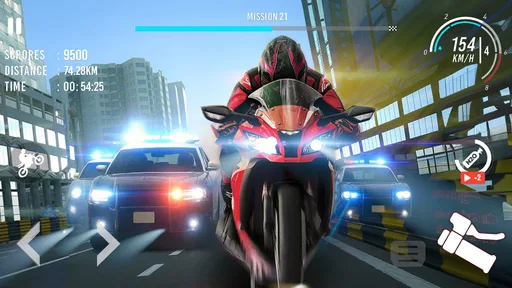
Our Review of Traffic Bike Rider Rush
 Analysis by Appyee
Traffic Bike Rider Rush is a free racing game from DT Trading Lab that puts one idea at the center of the experience: weaving a fast motorbike through city traffic for as long as you can. I spent time with it as the kind of game you open when you want immediate action rather than a long setup, and that focus is also its clearest identity. It is not trying to be a full motorcycle simulator or a story-driven adventure. It is a quick, endless 3D ride built around attention, timing, and the satisfaction of escaping one more vehicle.
That narrow purpose works surprisingly well when I have only a few spare minutes. The game starts from a simple premise, but the pressure rises naturally as traffic turns every lane change into a small decision. I found myself thinking less about reaching a finish line and more about reading the next gap before it disappeared. The real strength is its immediate traffic-dodging loop: simple to understand, difficult to perform consistently, and easy to revisit after a short break.
Why the traffic-dodging capability matters
Many mobile racing games divide their attention between vehicles, tracks, upgrades, missions, events, and visual spectacle. Traffic Bike Rider Rush takes a more direct route. Its main challenge is not learning a complicated racing system; it is judging space while moving quickly through a crowded urban road. That makes the game approachable for someone who does not normally play racing titles, while still giving experienced players a reason to improve their reactions.
In my experience, the most interesting part is the changing value of each opening. A gap that looks safe at one moment can become dangerous because another vehicle is approaching from the side or because the road ahead is already filling up. I had to look beyond the nearest car instead of reacting only to what was immediately in front of the bike. That small shift in attention is what turns the game from a basic steering exercise into a test of anticipation.
The endless format also changes how I measure success. In a conventional race, a mistake may simply cost a position before the next corner. Here, a poor decision can end the entire attempt, so patience becomes as useful as speed. I learned that moving constantly is not always the best approach. Sometimes the safer choice is to hold a line briefly, observe the traffic pattern, and wait for a cleaner opening rather than forcing a dramatic pass.
This makes the game especially suitable for short sessions. I can play it while waiting for an appointment, during a commute break, or at the end of the day when I do not want to remember a complex campaign. It also creates a natural “one more try” feeling without requiring a large commitment. The drawback is that players looking for a deeper career structure may find the central idea too concentrated. The traffic is the game, not merely one activity inside a larger package.
Reading the road instead of chasing speed
The most useful habit I developed was to treat the road as a sequence of decisions rather than a single rush forward. I started scanning two or three vehicles ahead, identifying which lane seemed likely to remain open, and then making a small adjustment instead of a last-second sweep. This approach made my rides feel calmer and more controlled, even though the game still kept its fast pace.
That technique matters because visual speed can tempt the player into overcorrecting. When traffic appears suddenly, a large movement may solve one problem while creating another. I had better results with deliberate changes that kept the bike positioned for the next gap. This is one of the less obvious lessons in the game: survival often comes from preserving options, not from taking the first opening available.
I also found it helpful to avoid treating every nearby vehicle as an immediate threat. Some situations look dangerous because the road is visually busy, but the actual safe route may be clear if I wait a moment and keep my attention forward. Conversely, a wide gap beside the bike can be misleading when the space ahead is closing. The game rewards a broader view of traffic, even though the controls and objective remain easy to understand.
How a typical ride feels in practice
A normal session begins with a low barrier to entry. I do not need to study a tutorial-heavy system before making progress. The basic goal is understandable almost immediately: keep moving, avoid city traffic, and extend the ride. That simplicity is valuable on a phone because it lets me return to the game without relearning a collection of menus or rules.
As the ride continues, concentration becomes more important than the opening seconds. Early traffic gives me time to settle into the road, but later decisions require quicker assessment. I noticed that fatigue affected my play more than I expected. After several attempts, I began making impulsive moves simply because I wanted to beat my previous result. Taking a short pause often helped more than trying to force another attempt.
For a realistic everyday example, imagine having ten minutes before a class or while waiting for a friend. This is where the game fits naturally. I can complete several focused attempts, stop after a mistake, and return later without feeling that I abandoned a long mission. It is also a good choice for someone who wants a racing game that can be played vertically in attention span, even if not necessarily in physical orientation; the important point is that the design feels built around quick engagement rather than extended sessions.
The game’s 3D presentation supports that purpose by making the traffic feel like a moving environment instead of a flat obstacle course. I paid more attention to vehicle spacing because the road had depth and motion. At the same time, players should not approach it expecting the detailed handling model of a dedicated console-style motorcycle simulation. The appeal is the rhythm of dodging, not mechanical realism.
Small habits that improve consistency
My first practical tip is to choose safety over a tempting shortcut when the road ahead is unclear. A narrow gap may look rewarding, but losing an attempt for a small gain is rarely worthwhile. I had more consistent rides when I planned the next move before entering the current gap.
Second, I recommend using the opening moments of a run to establish a visual rhythm. Rather than immediately making aggressive passes, I watched how quickly traffic appeared and used that time to settle my steering. This reduced the number of errors caused by reacting too early.
Third, I found that playing in short blocks is better than grinding while frustrated. The game’s simplicity makes repeated attempts inviting, but repetition can make attention sloppy. If I noticed myself moving before fully reading the road, I stopped for a while. That is a practical trade-off: the game is easy to restart, but improvement still depends on focus.
Finally, I would keep the phone’s screen clean and use a comfortable grip. That may sound obvious, but traffic-dodging games depend on quick visual decisions and controlled input. A slippery grip or obstructed display can turn a fair mistake into an avoidable one. These are not hidden upgrades; they are small changes in how I approach the game that make its central challenge feel more manageable.
Where it fits among mobile racing alternatives
Compared with arcade racers built around laps, Traffic Bike Rider Rush feels less concerned with route memorization. There is no finish-line strategy for me to learn; the challenge is adapting continuously to traffic. Compared with motorcycle simulators, it is lighter and more accessible, with less emphasis on realistic machine behavior. And compared with heavily structured racing games, it asks for less time before the fun begins.
That comparison also explains when another option may be better. If I want licensed vehicles, a detailed garage, long-term progression, or carefully designed tracks, I would look elsewhere. If I want a relaxed game with no pressure to react quickly, this may not be the right fit either. The endless traffic format can become repetitive for players who need frequent changes of objective.
On the other hand, the focused design is an advantage for people who dislike clutter. I do not have to commit to a campaign or learn a large collection of systems before enjoying a ride. The free entry point makes it easy to test that central loop, although optional in-app purchases range from $0.99 to $19.99 per item. I would treat those purchases as a personal choice rather than a reason to start playing; the main question is whether the traffic-dodging action itself holds my attention.
The game is marked for Everyone, which fits its straightforward racing premise. It is also available for devices running Android 7.0 or later, so many older Android phones can potentially meet the basic software requirement. Still, performance and comfort can vary between devices, and a fast traffic game benefits from a responsive screen. I would try a short session first rather than assuming that every phone will feel equally smooth.
What the audience response suggests
The game has reached over ten million installs and holds a 4.4 average from around thirteen thousand ratings, which tells me that its simple formula has found a substantial audience. I would not read those figures as proof that every player will enjoy it, but they do support the idea that quick motorbike traffic runs have broad appeal. The smaller review count, at 93 reviews, makes the rating less useful as a detailed explanation of every strength and weakness, so my own focus remains on how the core loop feels.
DT Trading Lab lists the current release as version 1.2.2. Since the game is relatively direct in purpose, updates matter mainly when they improve stability, handling, presentation, or the general feel of traffic encounters. I would pay attention to how the game behaves on my particular device, especially if I plan to play for longer periods instead of only making brief attempts.
Who will get the most from it
Traffic Bike Rider Rush is best for players who want a fast, uncomplicated racing break. It suits someone who enjoys reaction-based challenges, likes trying to beat a personal best, and does not need a story or a deep progression tree to stay interested. It can also work well as a first racing game for a casual player because the objective is clear from the beginning.
It is less suitable for anyone who expects a complete motorcycle career, realistic bike physics, competitive multiplayer structure, or a wide range of race types. Players who become bored when the same basic objective repeats should think carefully before installing it. The game’s value depends on whether refining traffic decisions feels satisfying to you; if it does, the focused design is a benefit, but if it does not, there is not much else to distract from that repetition.
I would also be cautious about playing it when I am tired or impatient. The game encourages quick retries, yet its best moments come from controlled observation. Someone looking for a completely mindless time-killer may find the need to concentrate more demanding than expected. Meanwhile, a player who enjoys small improvements will likely appreciate how one better decision can extend a run.
My recommendation after spending time with it
Traffic Bike Rider Rush succeeds because it understands the usefulness of a single strong idea. Dodging city traffic on a fast motorbike is easy to grasp, but the changing gaps create enough tension to make repeated attempts meaningful. I enjoyed it most when I stopped chasing reckless passes and started treating each ride as a lesson in timing and forward planning.
It is not the racing game I would choose for a deep, long-form experience, and its narrow endless format will not suit everyone. But as a free mobile game for short sessions, it has a clear purpose and delivers that purpose without unnecessary complexity. The release appeared on September 19, 2025, and its current version is 1.2.2, giving prospective players a straightforward entry point into the experience.
My final view is simple: install it if the idea of threading a motorbike through moving traffic sounds more appealing than managing a full racing career. I would recommend it to a friend who wants quick attempts, immediate controls, and a challenge based on anticipation rather than memorizing tracks. If you prefer deep customization or varied objectives, choose a broader racing alternative instead. For everyone else, this is a focused little game that can turn a spare few minutes into a surprisingly tense ride.
Verdict
Strengths of Traffic Bike Rider Rush
- Simple controls make it easy to start riding immediately.
- Short races are convenient for quick gaming sessions.
- Traffic-filled roads create constant tension and challenge.
- Bike upgrades add a sense of progression over time.
- Offline play is useful when you have no internet connection.
Limitations of Traffic Bike Rider Rush
- Repetitive roads and objectives can make longer sessions feel monotonous.
- Frequent advertisements may interrupt the gameplay experience.
- Difficulty can increase sharply in later stages.
- Limited customization reduces the feeling of owning a unique bike.
- Touch controls may feel imprecise during fast traffic maneuvers.
Other Releases by DT Trading Lab
View All
Traffic Car Pro - Driving Sim
Racing4.3
Similar Picks in This Category
View All
Hill Climb Racing
Fingersoft4.3

Dr. Driving
SUD Inc.4.2

Traffic Rider
skgames4.5

Asphalt 8 - Car Racing Game
Gameloft SE4.6

Race Master 3D: Car Racing
Beresnev Games4.6

Extreme Car Driving Simulator
AxesInMotion Racing4.3
Frequently Asked Questions
What is Traffic Bike Rider Rush?
Traffic Bike Rider Rush is a motorcycle racing game focused on weaving through busy roads while trying to travel as far as possible. The gameplay generally combines fast reactions, traffic avoidance, speed control, and score chasing. It is designed for short, action-packed sessions, with the main appeal coming from close passes, increasing difficulty, and the challenge of beating your previous distance or score.
How do you play Traffic Bike Rider Rush?
The basic objective is to control your motorcycle through moving traffic without crashing. Depending on the control setup, you may steer by tapping buttons, swiping, or tilting your device, while additional controls can be used for acceleration or braking. Staying alert is essential because traffic patterns change quickly. Learning when to overtake and when to slow down is more important than simply driving at maximum speed.
Is Traffic Bike Rider Rush free to download and play?
Traffic Bike Rider Rush can typically be downloaded without an upfront purchase, although the exact availability and pricing may depend on whether you are using Android or iOS. Free versions of racing games may include advertising, optional in-app purchases, or both. Before downloading, check the store listing for current details about ads, paid items, supported devices, and any restrictions that could affect your experience.
Does Traffic Bike Rider Rush require an internet connection?
The core riding experience may be playable offline, which makes the game convenient for quick sessions while traveling or when mobile data is unavailable. However, certain features can require an internet connection, including advertisements, purchases, leaderboards, cloud-related services, or updates. Because requirements can change between versions, it is best to test the game offline after installation rather than assuming every feature will work without connectivity.
Is Traffic Bike Rider Rush suitable for children and low-end devices?
Traffic Bike Rider Rush is generally easy to understand because its main concept is based on steering, avoiding traffic, and achieving a higher score. Nevertheless, parents should review the store age rating and any advertising or purchase options before allowing children to play. Performance can also vary on older phones, so users with low-end devices should check storage requirements, graphics quality, and reviews for possible lag or compatibility issues.
Play our best games!


